What a Sleep in Heavenly Peace build day actually looks like
Thomas Darby, a core team leader with Sleep in Heavenly Peace PA-Lock Haven, walks through a public bed build from machine setup to assembly. He explains what each station does, what first-time volunteers are asked to do, and what happens on delivery day.
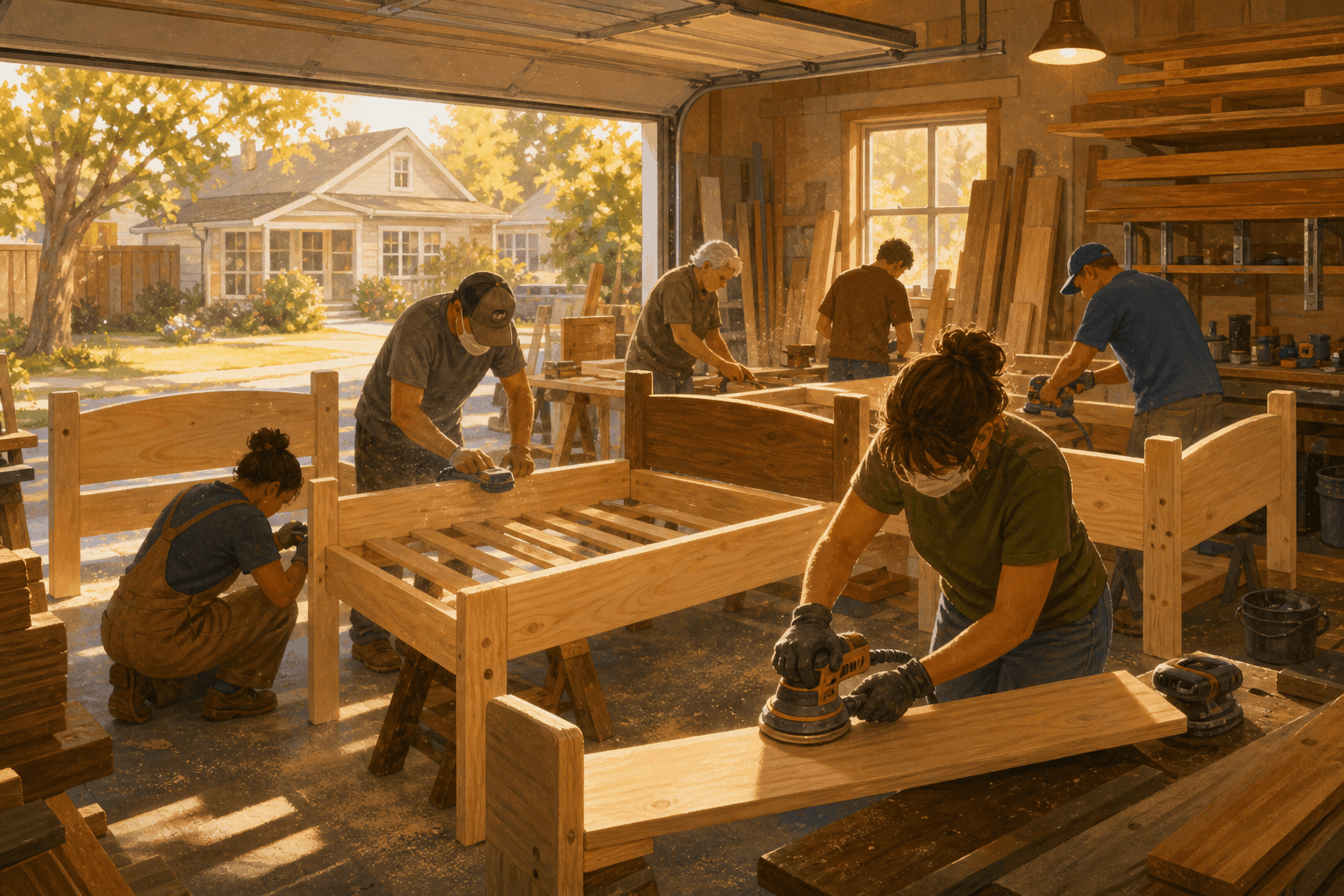
A build day is a warehouse full of mostly strangers turning stacks of lumber into finished bunk beds in a single morning. You sign in and sit through a safety and orientation briefing. Then you get assigned to a station: cutting, drilling, sanding, staining, branding, or assembly. Nobody expects you to arrive knowing how to use the tools. An experienced volunteer runs each station and teaches you there.
I am a core team leader with Sleep in Heavenly Peace PA-Lock Haven, the local SHP chapter, so I am usually on the floor well before the volunteers are. I wrote up the tool side of the same work, with photos of the stations, as a bed build case study on my contracting site.
Key points
- A public build runs like a volunteer assembly line, with a station for each step.
- Most people who show up have little or no tool experience, and that is expected.
- Experienced volunteers lead each station and coach first-time builders.
- The PA-Lock Haven chapter serves Clinton, Lycoming, and Centre counties.
- Beds go to local children who do not have a bed of their own.
- Delivery is a separate day from the build.
What happens before anyone shows up
Machine setup is the part nobody sees. Miter saws, drill presses, sanders, and the stain line all get placed and dialed in before the doors open. A station that needs adjusting mid-build is a station that stops moving material.
Floor layout matters more than people expect. Lumber has to travel from cutting to drilling to sanding to stain without doubling back across the room. Stained pieces need somewhere to dry where nobody will walk into them.
I would rather over-prepare a station than explain it twice over the noise of a full build floor. Once everyone arrives, we run the safety and orientation briefing and assign people to stations.
What each station does
Each station handles one step.
| Station | What you do | What a first-timer should know |
|---|---|---|
| Miter saw | Cut the standard bed parts to length | An experienced volunteer coaches you hands-on |
| Drill press | Drill the holes that bolt the bed together | Repetitive and easy to learn, with one setup to follow |
| Sanding | Sand every surface smooth | No experience at all, just patience |
| Stain line | Stain and finish rails and panels, then set them to dry | No experience, and expect to get stain on you |
| Branding | Add the brand mark to the rails | Quick to teach |
| Assembly | Put the parts together, then label and bundle each bed as a set | Mostly two people per bed |
Sanding is where I would put a nervous first-timer. It is the least intimidating job on the floor, and it genuinely matters. These are beds for kids, and nobody wants a splinter in a rail.
What a first-time volunteer actually does
You will be handed one job and shown how to do it. That is the whole ask. Some volunteers stay at one station the entire build and get very good at it, which the floor needs. Others rotate.
A lot of my own time goes to floating: moving between stations, restocking material, unsticking a bottleneck, and coaching people on the tools.
On November 15 I worked a build at SA Piper Logistics, my fifth SHP build. I helped my Leadership Clinton County teammates sign in and pick stations, then spent the day floating across sanding, cleanup, teardown, and hardware packing.
Floating is not the photogenic part of a build. It is the part that keeps a build finishing on time.
The noise and pace can be a lot if you are not used to a shop. Ear protection helps. So does telling whoever runs your station that you would rather be shown twice.
Who the beds are for
The beds go to children who do not have a bed of their own. Sleep in Heavenly Peace is a national nonprofit that builds and delivers twin bunk beds, and that is the whole premise. The mission is narrower and more concrete than most volunteer work I have done.
I do not see the family intake side, so I will not speak to numbers I have not touched. What I have seen is the delivery end. On October 11, 2025, Bobie-Jo Brungard and I rode along with a delivery crew for three hours.
We made seven stops, delivered and set up 11 beds, and took apart one existing bed for a family that was moving. At one stop, a neighbor walked over and donated to the chapter after watching the crew work.
The chapter was established in 2022. Local reporting documented its 200th bed delivery in July 2024, and more than 400 beds built and delivered by December 2025.
What happens after the build day?
A finished frame is not a finished bed yet. Volunteers match completed frames with new twin mattresses, sheets, pillows, and bedding, then deliver and install them in children's homes. The chapter collects new twin-size bedding at local drop-off locations, and needs a steady supply.
I learned about that need over lunch after the November build. Chapter president Laura Orndorf mentioned the chapter was short on new twin bedding for beds it was already delivering.
My four-person Leadership Clinton County team ran a holiday bedding drive from November 28 through December 24, 2025. We collected 92 new bedding items plus cash donations. We delivered everything to Great Island Presbyterian Church for SHP to distribute with future beds. Our three campaign posts were shared more than 200 times, which surprised me more than anything else about the drive.
If you are thinking about going
Go. You do not need tools, skills, or a group. The chapter posts public builds, and there are private sponsor-led builds as well.
My last build was February 28, 2026, a large public one. I spent two and a half hours on the sticker and staple station, then moved to the cutting line to keep lumber flowing where it was needed. I did not touch a saw for the first half of the build, which would have disappointed me a few builds ago.
The saw stations are always covered. What runs short is people willing to work the quiet end of the line, and I would rather stand there than watch the build stall behind me.
Want to get in touch?